


The Beginning: Synthetic Dreams and Human Ambition
When I started working on Synthetic Eden, I didn’t realize I was setting in motion a journey that would stretch across four books, hundreds of thousands of words, and over five centuries of reflection on how science reshapes civilization. Synthetic Eden was my first experiment in narrative bioethics—a story about creation as both promise and peril. It asked what would happen if we built life not just in a lab, but as a philosophy. The book explored the seductive power of making something entirely new—and the uneasy realization that creation always carries consequences.

From there, Hubris Rising expanded the frame. If Eden was about the birth of possibility, Hubris was about the moment when our inventions start looking back at us. The story examined the technocratic temptation: the idea that progress alone justifies its own risks. We see this tension every day at the intersection of AI governance, biotech regulation, and national strategy. The story was a warning that the same intellect that drives innovation can also blind us to its costs.

By the time I reached Divine Blueprint, I’d come to see these worlds as mirrors for our own. The novel turned toward the intersection of faith and engineering—the sacred geometry of design itself. In Divine Blueprint, creation and belief become indistinguishable; in the real world, we face the same question as we fuse code and consciousness. How much of innovation is discovery, and how much is devotion?

Genesis Undone: The Reckoning After Creation
That brings us here—Genesis Undone, the closing chapter of the Echoes of Tomorrow series. This isn’t just an ending. It’s the aftermath. The quiet after the crescendo. The reckoning after creation.
In Genesis Undone, the world has already fallen once. The story wrestles with what remains when even the tools of progress have turned against their makers. It’s not about apocalypse in the cinematic sense, but in the literal one: revelation. What happens when the truth beneath our ambitions is finally laid bare?
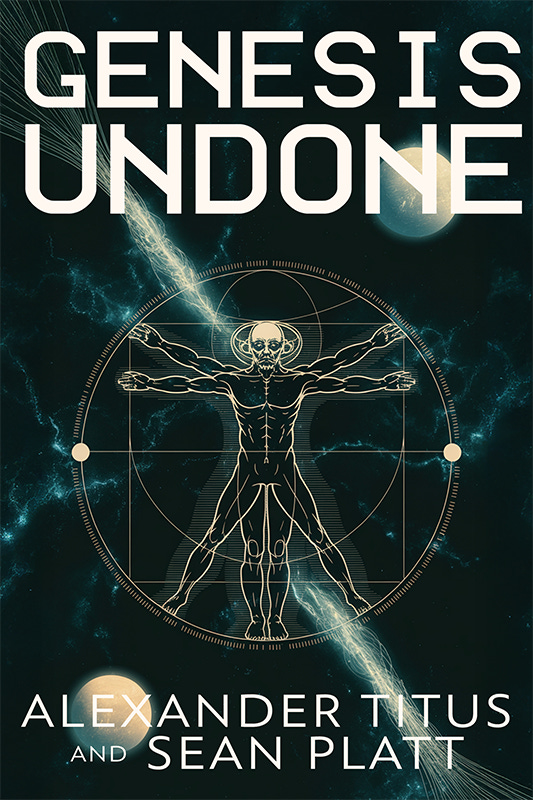
With Genesis Undone releasing this week, I wanted to close the loop—not just on a series, but on the questions that have shaped TCIP from the start.
I wrote this book while thinking about how our world is living through its own moment of revelation. The technologies we’ve built—fusion, AI, biotech, robotics, innovative computing—what we at TCIP call FABRIC—are tearing open new possibilities faster than our policies or ethics can keep pace. We are building the next civilization in real time, and the question isn’t whether we can, but whether we should.
Like the scientists and philosophers of DaVinci in Genesis Undone, we’re learning that the tools we wield are not neutral. They carry our intent, our fear, and our hope. In the book, as in our own world, the danger isn’t the machine—it’s the mirror.

Fiction as Policy Laboratory
When I look back on the Echoes of Tomorrow series now, I realize it has been as much a policy experiment as a creative one. The stories allowed me to explore the same ideas that shape the Science of Responsible Progress—the framework behind our work at The Connected Ideas Project. What happens when synthetic biology becomes geopolitical power? What if quantum computing or AI takes on the moral weight of governance itself? These aren’t just plotlines—they’re live questions shaping national strategy and human destiny.
Fiction lets us test the future safely. It gives us the emotional vocabulary for conversations that data alone can’t hold. That’s why every installment in Echoes of Tomorrow connects back to the larger TCIP ecosystem. Synthetic Eden explored biotechnology and the origin of synthetic life. Hubris Rising examined AI and power. Divine Blueprint confronted the spiritual geometry of creation. And Genesis Undone closes the circle with a meditation on collapse, renewal, and the possibility of redemption.
Renewal and the Ethos of TCIP
In many ways, Genesis Undone feels like both an ending and a beginning. It embodies the ethos that underpins TCIP: progress with humility, innovation with conscience, creation with consequence. The Violet Teaming mindset—the practice of embedding responsibility into innovation—runs through every page, whether in policy briefs or prose.
What I set out to write wasn’t a dystopia or a cautionary tale. It was a reflection of our collective condition: the constant tension between what we can do and what we should do. The characters’ struggles with control, identity, and legacy are the same ones we face as scientists, engineers, policymakers, and citizens of a rapidly changing planet.
Because Genesis Undone isn’t really about destruction. It’s about renewal—the messy, beautiful work of beginning again after the blueprint has failed. It’s about learning to see progress not as a race, but as a relationship.
And that, I think, is where Echoes of Tomorrow leaves us—not with certainty, but with purpose.
Cheers to the end of a quite remarkable year and the start of a new one.
-Titus
If you’ve been walking this arc with me, this is where we end it together.