

There are two industries I cannot stop thinking about. Biotechnology is the one I believe matters most. Artificial intelligence is the technology I am most excited about. For most of my career I have worked somewhere in the space between them, trying to understand what becomes possible when computation begins to change our ability to read, design, and ultimately engineer biology.
The possibilities are extraordinary. New medicines designed faster. Clinical programs that learn continuously. Scientists relieved of administrative work that consumes their attention without benefiting patients. Organizations able to connect information across functions, identify patterns earlier, and make better decisions with less friction.
But possibility is not the same thing as capability. That distinction has become increasingly difficult for me to ignore.
The AI conversation in biotechnology is currently dominated by models, vendors, partnerships, pilots, and announcements. Companies are buying licenses. Teams are experimenting with tools. Executives are being told that everything is about to change. And some of it will.
But buying AI is easy. Becoming a different company is the hard part.
A different company is not a different tech stack. It is a different culture: how people work, what they are willing to let go of, and whether the organization can learn a new way of operating and make it hold. AI transformation is a people transformation wearing a technology costume. Lead it people-first, or it does not stick.
That is the problem I am building a new project to address. It is called Translational Intelligence: an open operating system for building an AI-native biotech, a growing body of frameworks, tools, case studies, and practical guidance for turning technological possibility into institutional capability.
It’s a new free publication accessible at translationalintelligence.com.
Not someday. Not in a theoretical company unburdened by regulation, legacy systems, scientific uncertainty, organizational politics, or limited resources. Inside real biotechnology companies, as they exist today.
The missing translation layer
Biotechnology already understands the importance of translation. A scientific discovery is not a medicine. Between the two sits an enormous amount of work: validation, development, manufacturing, clinical testing, regulation, financing, and execution. Progress depends on translating knowledge from one context into another without losing what made the original insight valuable.
AI transformation has a similar problem. A capable model is not a capable organization. The distance between those two things is where most transformations fail.
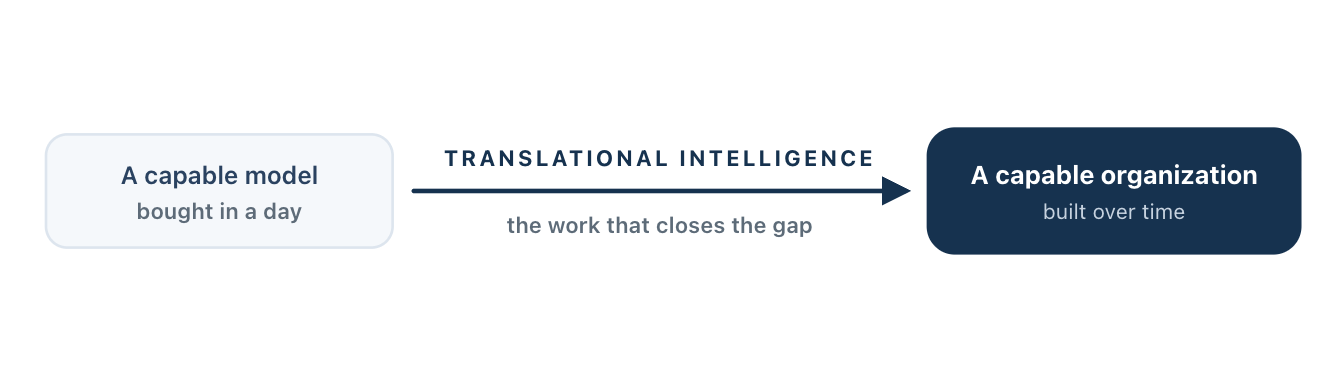
A tool can produce an impressive demonstration while changing almost nothing about how the company actually operates. A team can launch dozens of pilots without creating a single durable workflow. Employees can receive access to powerful systems while remaining uncertain about when they are permitted to use them, how their work will be evaluated, or who is responsible when something goes wrong. The technical layer may be working perfectly. The institutional layer is not. And the institutional layer is people: their habits, their incentives, and whether they are willing and able to work a different way.
Translational intelligence is the ability to close that gap. It is the discipline of converting emerging technical capability into repeatable human and organizational capability. That means answering questions that are less glamorous than “Which model should we use?” but far more consequential. Who is allowed to use AI, with which information, for which kinds of work? Who owns the translation between a business problem and a technical system? How do you distinguish a useful workflow from an attractive demo? When should a company buy, build, configure, or simply redesign the underlying process? These are not primarily questions about technology. They are questions about institutions.
Why I am building this
I have spent more than a decade working with artificial intelligence and the last several years helping organizations rebuild themselves around it. That work has taken me through science, national security, public policy, technology companies, and biotechnology. I have seen AI from the perspective of the researcher, the operator, the executive, the policymaker, and the person standing in front of a team trying to explain what all of this means for their work on Monday morning.
The consistent lesson is that the human and organizational work is most of the job, by a wide margin. Not as a polite aside. Most of it in the literal sense: get the people and the culture wrong and nothing else you do will matter, get them right and the rest becomes tractable. This is a cultural change first, led people-first, and every framework and tool here exists in service of that.
The model matters. The data matters. The software matters. But none of them become capability on their own. Companies change when people have permission to act, someone is responsible for translating possibility into a real product or workflow, and programs exist to move the organization from scattered experiments toward sustained execution. I describe those three requirements as Permission, People, and Programs. Permission establishes the rules of the road. People create ownership and translation. Programs turn isolated successes into institutional learning. Of the three, People is usually the hardest, and the one that decides whether the rest becomes real. Permission and Programs are how you make the human change possible, and they matter in their own right. The human change is the transformation.
It is a simple framework. I do not pretend it is the final word. But it has proven useful because it forces leaders to confront the parts of AI transformation that cannot be solved through procurement.
What I am building
The project begins with a foundational collection that lays out the central argument: AI transformation is not fundamentally a software deployment. It is an operating-model redesign. From there, the site is organized into layers.
The Foundations explain the core doctrine: what translational intelligence is, why Permission, People, and Programs matter, how companies should think about buying and building, why the AI Product Partner is becoming a critical organizational role, and what an AI-native biotech might ultimately look like. The Issues develop those ideas through longer arguments, one a week. The FAQs give shorter answers designed to be sent to a colleague, executive, or board member when a practical question arises. The Artifacts translate the ideas into usable tools: maturity assessments, operating models, implementation plans, AI policies, build-versus-buy frameworks, and functional maps showing where AI can, and cannot responsibly, touch the work of a biotech.
The Case Studies document what happens when these ideas encounter real institutions: what worked, what failed, what produced measurable value, and what turned out to be more difficult than the framework suggested. That last category matters enormously. A framework should not be trusted because it is persuasive. It should be trusted because it survives contact with reality. I am still building that body of evidence, and some of the earliest case studies come from my own work. Over time, I hope others will contribute examples, corrections, counterarguments, and lessons from their own transformations. The ambition is not to make Translational Intelligence a record of what I believe. The ambition is to make it a reliable source of what the industry is learning.
Healthy ambition requires credible humility
I believe biotechnology has the potential to become one of the industries most profoundly changed by artificial intelligence. I also believe it may be one of the easiest places to get that transformation dangerously wrong. Biology is complex. The data is fragmented. The work is specialized. The consequences are real. Much of the industry operates within scientific, clinical, regulatory, and quality systems where a confident answer is not necessarily a correct answer, and where an efficient mistake can be far worse than an inefficient process.
There is no serious version of AI-native biotechnology built on technological enthusiasm alone. The work requires restraint, evidence, domain expertise, careful governance, and respect for the humans who remain accountable for the result. That is why the project holds itself to explicit editorial standards. Claims are distinguished as doctrine, operator heuristics, evidence-backed conclusions, or regulatory guidance. Primary sources are used wherever the stakes require them. Frameworks are versioned and revised as the evidence changes.
I will get things wrong. The industry will discover better approaches. Some ideas that appear universal will turn out to depend heavily on company stage, therapeutic modality, function, or culture. That is not a weakness in the project. It is the point of building it in public. We do not need another voice pretending the future has already been solved. We need a place serious people can work through it together.
The work ahead
Translational Intelligence sits at the intersection of science, technology, institutions, and human behavior. It asks not merely what AI can do, but what kind of organizations we must become to use it responsibly and well. And it is focused on an industry whose success can quite literally determine how many people live, how well they live, and which forms of suffering remain inevitable. That deserves more than hype. It deserves a serious operating discipline.
So start with the argument this is all built on, the biotech of tomorrow, and follow the Foundations in order. Use the artifacts. Send the pieces to your teams. Challenge the assumptions. Tell me where the frameworks break. The future of biotechnology will not be determined by which companies had access to artificial intelligence. Nearly all of them will. It will be determined by which institutions learned how to translate that intelligence into better science, better decisions, and better outcomes for human beings. That is the work ahead.
Cheers,
—Titus


