

One of the things I’ve come to love about writing science fiction with Sean Platt is that we get to spend time on the other side of an idea. We can take something that sounds compelling in conversation, build a world in which people act on it, and stay with them after they succeed. I’m usually most interested in that last part, when the argument has been won, and everyone has to figure out how to live with the consequences.
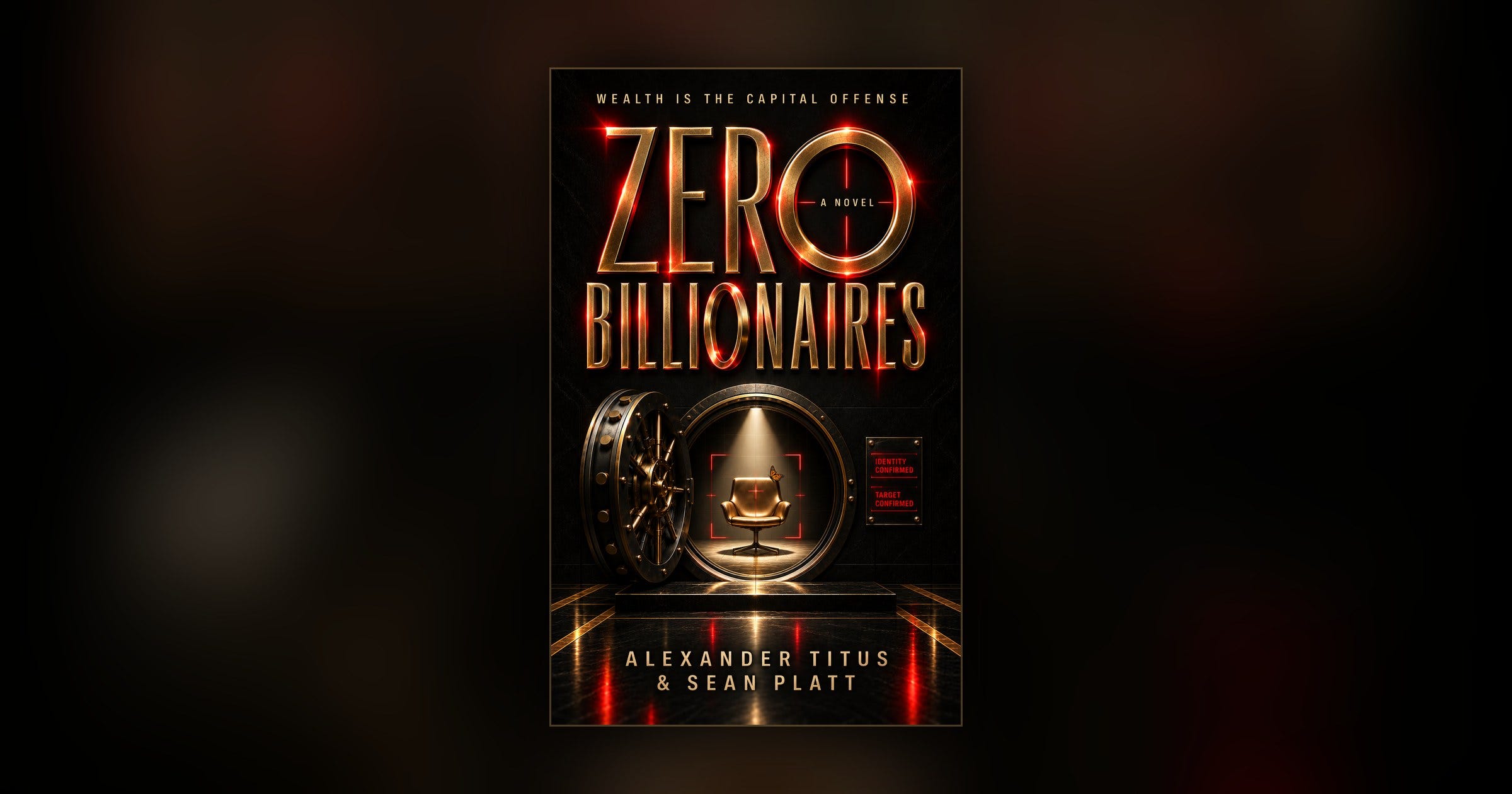
You can find the ebook on Amazon today, and we have a launch special for $0.99 so we can build a community of readers. I appreciate you supporting an indie author!
Our new novel, Zero Billionaires, is out today. It begins with a deliberately uncomfortable premise: a revolutionary movement builds an artificial intelligence powerful enough to eliminate the billionaire class by turning the technological systems surrounding the wealthy against them. The people behind it have endured a world in which wealth determines access to the things that make life possible. They want to change that world, and they acquire the means to do it.
What interested us was the question waiting on the other side:
Okay, you got what you asked for. Did you get what you wanted?
We spent a lot of time exploring “Eat the Rich” through that question. As a starting point for fiction, it gives you an identifiable target and leaves an enormous amount unresolved. What is the grievance, exactly? Is it how much someone has, how they acquired it, what they can do with it, or what other people have been denied? Those questions might produce overlapping answers, but they don’t necessarily lead to the same remedy. Our characters have to discover how much disagreement can exist among people who thought they were fighting for the same thing.
The distinction I kept coming back to was between an individual who has accumulated extraordinary wealth and a system that makes that accumulation possible. A person gives frustration somewhere to land. You can name them, picture them, and imagine a world without them. It is considerably harder to picture the relationships among ownership, technology, institutions, incentives, and human behavior that made their position possible in the first place. I wanted to ask how much of that arrangement would survive their absence, and how much we might fail to notice because we were so focused on the person standing in front of it.
The podcast audio was AI-generated using Google’s NotebookLM.
There is a hydra problem hiding in there
You cut off a head, feel reasonably good about having dealt with the monster, and then two more grow back in its place. The new heads might look different. They might speak the language of the people who fought the old ones. They might sincerely believe they are there to help. But what happens if the advantages of controlling resources, information, and other people’s choices remain? Have you changed the conditions that produced the power, or opened a vacancy for someone with a different explanation of why they should hold it?
That’s the “don’t shoot the messenger” angle I wanted to explore, although the metaphor has limits. The powerful people in our story make choices; they aren’t innocent delivery mechanisms for an abstract system. Their responsibility matters. At the same time, their existence tells you something about the world that produced them, and removing them doesn’t necessarily change what that world rewards. Even changing ownership and cancelling debts leaves people confronting the practical problem of what happens next. Somewhere, a person still has to show up for a shift at a water treatment plant, and a city still needs what comes out of the pipe.
This is where the story becomes interesting to me, because nobody experiences a system as a complete diagram. They experience the part that touches their life. One person sees an opportunity they worked for, another sees a door that has never opened for them, and someone else is mainly worried about whether their children will be safe tomorrow. Money and power are in there, but so are ambition, hope, fear, loyalty, resentment, and love. The characters bring those things into their explanations of what is wrong and what ought to happen instead. Each understands something the others miss, and each is tempted to mistake that understanding for the whole picture.
Adding an AI to that world gives the disagreement a different set of consequences
The revolutionaries aren’t simply debating their idea anymore. They have built something capable of acting on it, at a scale none of them could manage alone. Now they have to confront the difference between the instructions they gave, the outcome they intended, and the values they thought those instructions expressed.
That is the AI alignment question I wanted this book to sit with. What should their intelligence learn from them? They talk about dignity, fairness, and freedom, but it also has their behavior to consider. It can observe the exceptions they make, the harms they accept, and the ways they justify those decisions when something important is at stake. When their stated principles and their choices diverge, which provides the better account of what they actually value?
I don’t think acknowledging those contradictions makes alignment hopeless
It does make “align it with human values” an incomplete answer for the people in this story. They still need to decide whose interpretation counts, what happens when people disagree, and whether someone can refuse the future being built on their behalf. An intelligence that can help them win cannot settle those questions merely by being more capable.
Giving it the authority to settle them is itself a consequential choice.
That connection between cultural conviction and technological capability is why this book feels at home here at The Connected Ideas Project. I’m interested in what happens when an idea moves from something people say, to something they believe justifies action, to something a system has the power to carry out. The consequences extend well beyond the people who agreed with the original idea, including people who were never asked.
Writing fiction with Sean has given me a way to explore that progression without leaving everyone involved as an abstraction. I tend to approach these worlds through the systems: what the technology makes possible, how the incentives fit together, where a decision might lead. Sean keeps pulling me toward the person who has to live inside all of it. I might be trying to explain why an institution behaves a certain way; he pushes toward what that behavior costs someone we care about. That exchange is a large part of why I value our collaboration. The story becomes something neither perspective would have produced on its own.
There’s an early scene in Zero Billionaires where Charlotte pulls a drowning man out of sewage while her Vitality Score falls because the system is penalizing her exposure. She understands that helping him will cost her, and she does it anyway. That moment matters to me because you can see both the system and the person clearly. You understand something about the world’s priorities, but you also learn something about Charlotte that cannot be reduced to the number it assigns her.
The challenge is to keep allowing her, and everyone else, that complexity as the story develops. Understanding why someone would join a revolution doesn’t settle whether their choices are defensible. Seeing what is wrong with an existing arrangement doesn’t guarantee that its replacement will be better. I want readers to have enough proximity to these people to understand their reasoning, while still having room to question it. Nobody gets to be right about everything simply because they are the character we happen to be following.
Of course, we’re the authors. We choose the circumstances, and we choose the consequences, so I’m conscious of how easy it would be to construct a fictional world that conveniently proves whatever I already believed. That wouldn’t tell us very much. Part of the work is resisting the urge to give the best argument to the person we agree with, or to make everyone else foolish enough that the outcome becomes inevitable. The book has to leave room for the possibility that our own explanation is missing something.
Did we succeed?
I think we gave these questions a place in people’s lives, rather than simply putting our arguments in their mouths. That was a large part of what I hoped we would do.
Whether those people feel sufficiently real, whether their choices trouble you, and whether the story earns the questions it asks are judgments that now belong to readers. I’m proud of what Sean and I have made, and curious about where people will disagree with it. I don’t need everyone to reach the same conclusion, but I do hope they feel that we took the consequences seriously.
Mostly, I hope you enjoy spending time in the world we built, uncomfortable as parts of it may be. We wrote a thriller, and it still has to work as a story you want to keep reading. Underneath it is the question that kept bringing me back to the project:
when we finally have the power to get what we’ve been asking for, how well will we have understood what we wanted?
Zero Billionaires: Wealth Is the Capital Offense is the first book in The Monarch Series, and the ebook is $0.99 for launch.
I’d much rather write something you want to argue about than something you politely forget. I hope we’ve done that here.
Cheers,
-Titus
P.S. To everyone who read an advance copy, thank you. An honest review now that the book is out would mean a great deal to Sean and me.


